


Individuals
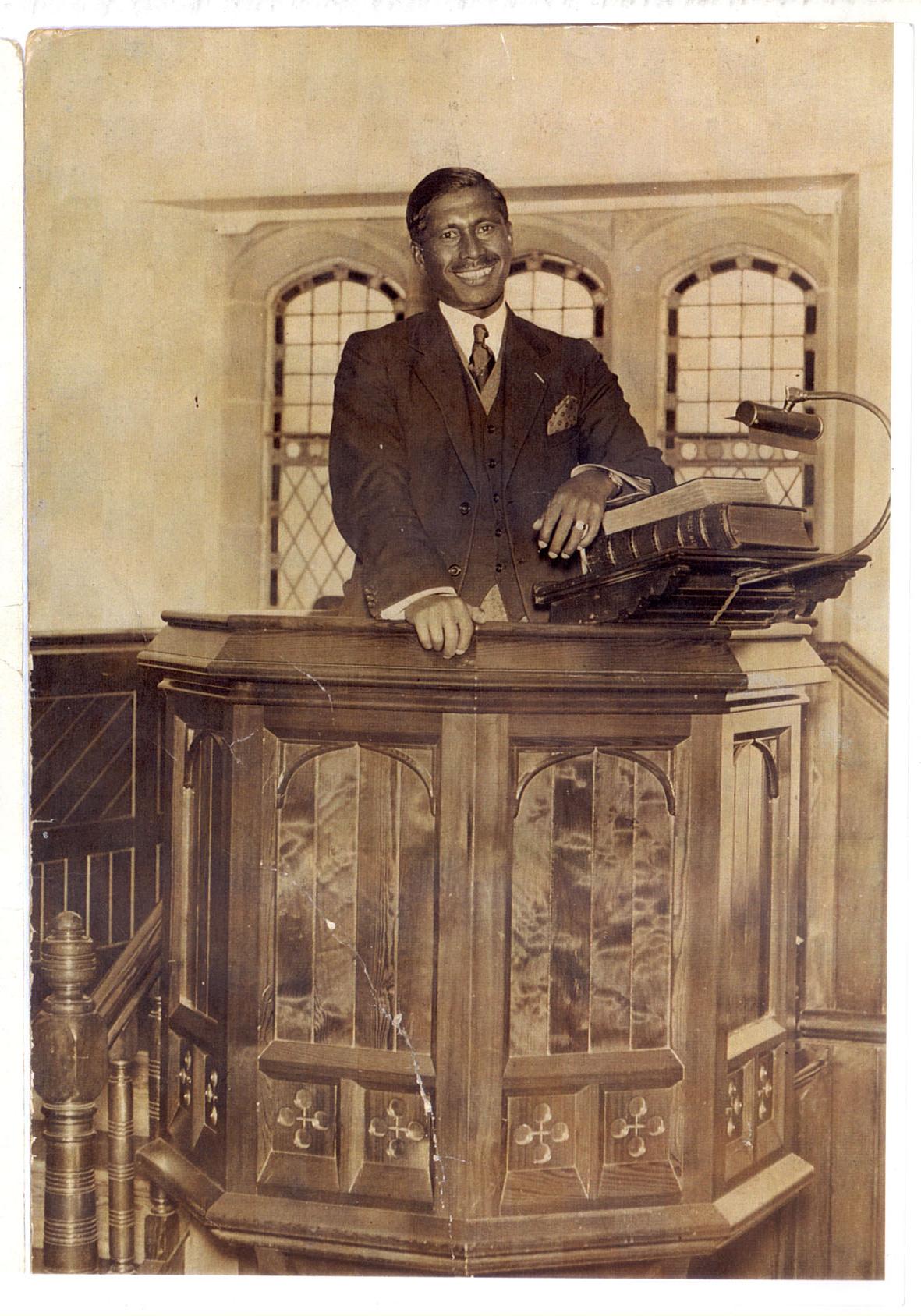
Kamal Chunchie
Kamal Athon Chunchie was a Methodist pastor and founder of the Coloured Men’s Institute. He was born in Sri Lanka to a Muslim family on the 4th June 1886, and enjoyed an active childhood.
In 1915 he enlisted in the Public Schools Battalion and saw action in France and Selonika and was wounded twice. In 1917 he converted to Christianity and arrived in London in 1918. Towards the end of the war, he met Mable Tappen a member of the Women’s Army Auxiliary Corps. They married in July 1920 and had one daughter, Muriel.
In December 1921, Chunchie began to work as a missionary for the Wesleyan Methodist Missionary Society. He worked alongside the Asian, Chinese, African and Caribbean sailor community in Canning Town. Initially he took up a position at the Queen Victoria Seamen's Rest in Poplar. He would visit the local residents and the seamen population in ships, preaching to them and providing material assistance. Chunchie spoke out against racism and the plight of the dispossessed which he saw as incompatible with Britain's Christian values.
In 1923, in a rented hall in Swanscombe Street, Chunchie founded the Docklands' first black Wesleyan Methodist church, and a Sunday school. In his efforts to counter racist discrimination of the black and Asian population he lobbied for the establishment of an organization that catered for London’s East End’s black and Asian community, a plan that came to fruition in 1926 with the establishment of the Coloured Men’s Institute in Tidal Basin Road, Canning Town. It was a religious, social and welfare centre for sailors and local residents with Chunchie as the pastor and warden. The work grew quickly initially catering for 50 people, but soon it impacted up to 200 people.
From 1926 until the centre's demolition as part of the West Ham Road widening scheme in 1930, Chunchie worked tirelessly as a fund-raiser to keep the centre open, addressing Methodist gatherings all over the UK. He was an accomplished speaker, invoking the Christian ideals of equality and brotherhood to combat racism.
At the closure of the institute, Chunchie and his family moved to Lewisham. He worked hard to rebuild the institute and continued to serve the community while living in Lewisham. However his hard work and the dwindling finances had a negative impact on his health and after a short illness, he died in June, 1953, aged 67 and is buried in Hither Green Cemetery, Lewisham.
Image: Kamal Chunchie, Courtesy of Newham Archives

